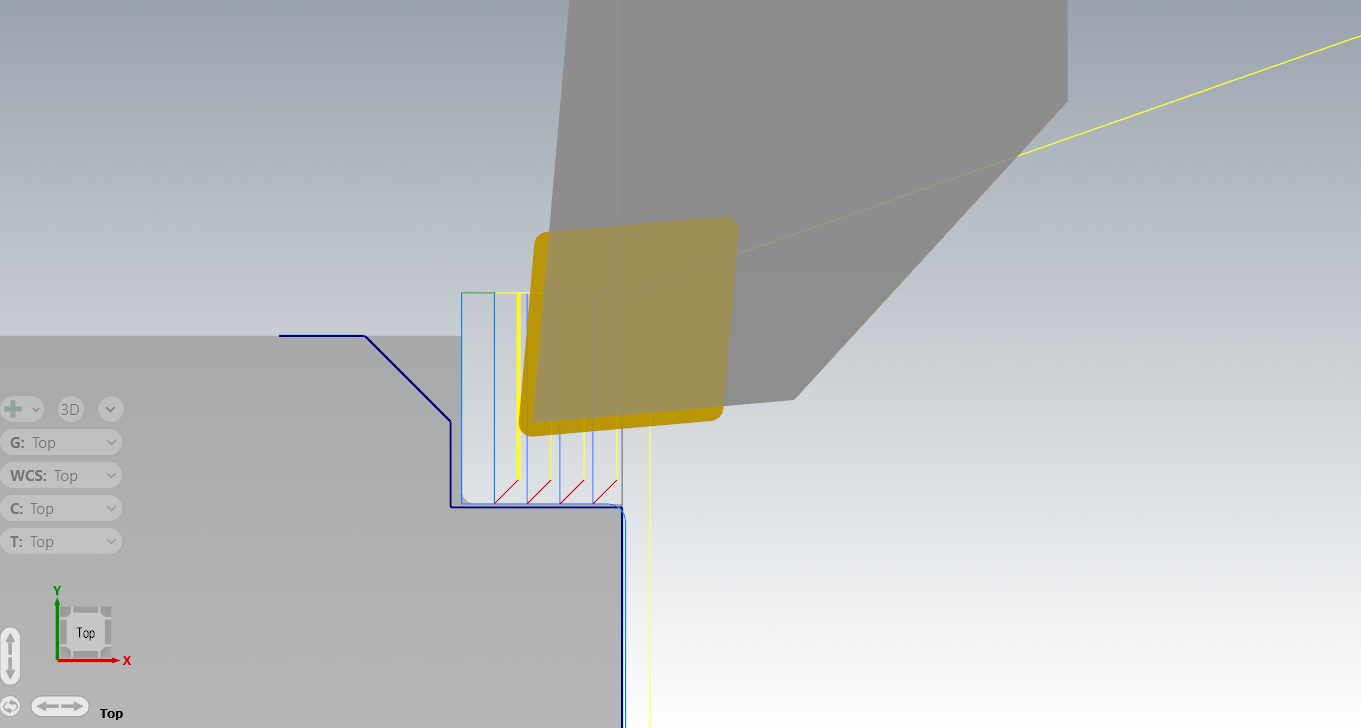
G72 Facing Cycle
The G72 Facing Cycle (also known as the Transverse Roughing Cycle) is a canned cycle used on CNC lathes to remove stock by cutting across the face (X-axis) rather than along the length (Z-axis). It is essentially the "vertical" version of the G71 longitudinal cycle.
Two-Line Format (Common on Fanuc/Haas)
Most modern controls use a two-block format to define the cutting behavior and the profile range.
Line 1: Cutting Parameters
G72 W(d) R(e) ;
- W(d): Depth of cut for each pass in the Z-axis (given as a positive value).
- R(e): Retract amount after each cut (the distance the tool pulls back before returning for the next pass).
Line 2: Profile & Finishing Allowances
G72 P(ns) Q(nf) U(u) W(w) F(f) ;
- (ns): Starting sequence number (N) of the profile subroutine.
- Q(nf): Ending sequence number (N) of the profile subroutine.
- U(u): Finishing allowance in the X-axis (diameter).
- W(w): Finishing allowance in the Z-axis (face).
- F(f): Feed rate for the roughing passes.
When to Use G72
- Facing Large Surfaces: Ideal for removing material from the front face of a part.
- Wide Shoulders: Best for parts where the radial (X) dimension is much larger than the axial (Z) dimension.
- Chip Control: Sometimes preferred over G71 to prevent long "stringy" chips from wrapping around the part or tool during OD turning.
Programming Example
This example roughs a face from an initial stock position to a specific profile.
G0 T0101
M8
G97 S90 M03
G0 G54 X72.828 Z0.
G72 W2. R.2
G72 P100 Q102 U.4 W.2 F.2
N100 G0 Z-16.414 S90
G1 X71.891
X59.531 Z-10.234
G2 X58.4 Z-10. I-.566 K-.566
G1 X50.
Z-.8
G2 X48.4 Z0. I-.8
N102 G1 X0.
G0 X72.828
M9
G28 U0. W0.
M05
Key Differences: G71 vs. G72
| Feature | G71 (Turning) | G72 (Facing) |
| Cutting Direction | Parallel to Z-axis | Parallel to X-axis |
| Depth of Cut | Defined by U in first line | Defined by W in first line |
| Best For | Long, slender parts | Flat, disc-like parts |
Important Tips
- Monotonicity: In a Type I cycle, the X-axis must move in one continuous direction (always increasing or always decreasing) within the P and Q blocks.
- Starting Position: Always ensure your tool is positioned at a "safe" X and Z coordinate before calling the G72 cycle to avoid crashes.
- Z-Movement: Unlike G71, the first line of your profile (N100) in a G72 cycle typically defines a movement in the Z-axis.
Join TSRCNC Community
Join as Educator: Create your own course and sell it on our platform.